
What is the point of therapy?: race, culture & neurodiversity
As a neurodivergent therapist and therapy client, I continue to learn and grow in my understanding of what this strange ritual of “therapy” is. In fact, the very idea of a person being “mentally healthy” sometimes seems ridiculous to me. I mean, who is this mentally healthy person anyway? Are they always happy, able to quickly bounce back from hard things with acceptance and grace? Do they fit into society with ease, like putting on a well-worn pair of comfy jeans? Maybe they have attained some form of enlightenment through dedicated meditation practice, or perhaps they were just born that way with lucky genetics. I have yet to really figure it out for myself. But I do know that mental health for me includes being connected to myself, family, community, and the world in a way that feels genuine and real.
I have seen many therapists from a young age, and most of my therapists have been kind and compassionate. Even so, I have walked out of many therapist appointments feeling defensive, defective, and closed. Sometimes I felt the need to justify my worldview, values, and experiences. It would often feel as if the therapist had all the answers, but I was somehow incapable of understanding them. There was something wrong with me. Sometimes I would shut down inside during the session, but on the outside, I would do my best to be a “normal” client. What is going on here?
Hegemony, mental health, and therapy
Cultural hegemony refers to the ways in which dominant culture, worldviews and values are pushed onto individuals and communities. The beliefs, values, and world view of the dominant class become the “normal” – perhaps a hegemonic normalcy. Ways of being that conflict with this hegemonic normalcy are stigmatized, excluded, and marginalized in other ways (Gramsci, 1992). Research on mental health in media can provide some examples of this phenomenon. In a 2023 report that reviewed the top 100 films of 2022, they found that individuals with mental health struggles were overwhelmingly depicted as violent (72%) and not seeking therapy (only 25%) (Pieper et al., 2023). The message is clear: individuals with thoughts, feelings, moods, and beliefs that stray from hegemonic normalcy are not just “mentally ill,” they are dangerous. When we are repeatedly exposed to these messages, we will eventually internalize these ideas. It becomes “common sense” that our society would promote involuntary hospitalizations, imprisonment of individuals who need treatment, and even the state-sanctioned execution of citizens whose only crime is experiencing bipolar symptoms of mania (Yong Yang, Jason Lee Maccani, Walter Wallace Jr., etc.).
White-body supremacy and racial trauma
Resmaa Menakem provides us with another perspective on this phenomenon. Resmaa uses the term White-Body Supremacy (WBS) to descried how a stereotyped “whiteness” is made to be the hegemonic normalcy. This whiteness is unwittingly internalized in our bodies, minds, and spirits. The emotional, mental, and spiritual distress caused by WBS impacts both bodies of culture (BIPOC individuals) and white bodies (white individuals) in the form of trauma which can be passed down for generations (Menakem, 2017). Kenneth Hardy details this impact in his book “Racial Trauma,” where he outlines some of the mechanisms of WBS and the impact an individual’s sense of self-worth, worldview, emotional regulation, sense of safety and trust, and thought processes (2023).
White supremacy culture
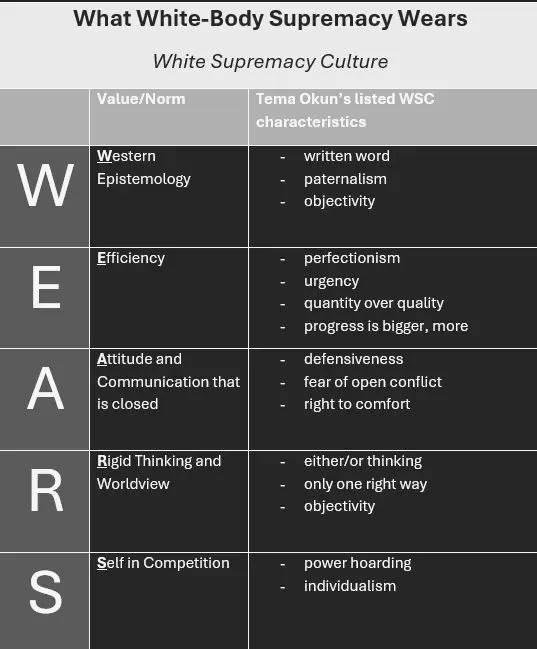
Tema Okun offers us specific language to describe the racialized values and characteristics of hegemonic normalcy in the US. She notes that White Supremacy Culture (WCS) causes all members of a society pain, distress, and dehumanization. Many of the WSC characteristics overlap with other powerful systems such as capitalism, sexism, and eurocentrism. WSC can be grouped into five categories: 1) Western epidemiology, 2) Efficiency, 3) Attitude and communication that is closed, 4) Rigid thinking and worldview, 5) Self in competition (2020). It should be noted that these values are not inherently “bad.” But when all other perspectives and worldviews are subordinated and excluded, the result is an unbalanced and dehumanizing society for all of us.
Hegemonic normalcy and the brain
Hegemonic normalcy can dictate who among us is deemed intelligent, mentally healthy, and sane by endorsing the ideal of the neurotypical brain. An individual with a neurotypical (or neuroconforming) brain is someone who can easily adopt the dominant way of interpreting, thinking, emoting, and communicating in a society. Individuals who show signs of ADHD, autism, dyslexia, etc. are deemed abnormal and disordered through pathologizing language and stigmatizing “therapies” (e.g. Applied Behavior Analysis). Neurodivergent folks frequently must mask their thoughts, feelings, and behaviors to access needed resources and opportunities (Walker, 2021). Folks with neurological differences can internalize these messages that they are “disordered,” or have “functional deficits.” Masking, stigma, and social rejection can cause serious mental[1] health issues including shame, emotional distress, substance use, and even suicide (Happé & Frith, 2020).
Weapons of whiteness and normalcy in mental health
When it comes to mental health, we can see many ways in which individuals who do not conform to the dominant culture are devalued, excluded, and pathologized. The Diagnostic Statistical Manual (DSM) has long stood as the arbiter of mental health and mental disorder. This authoritative book legitimizes the use of stigmatizing disordered-based labels for individuals experiencing suffering. This authoritative book is used to uphold white supremacist culture through labeling and pathologizing individuals experiencing suffering, resulting in racial diagnostic disparities among people of color (Riquino, et al., 2021). The stigmatizing language and individualistic framing of suffering of the DSM not only impacts the way in which providers think about mental health, but reinforces these ideas among popular every day discourse (Lafrance, et al., 2013). The DSM acts as a cornerstone of the overall Eurocentric and medicalized approach to helping others in emotional and mental distress in the context of oppression and marginalization. It has been used to uphold a view of mental health that focuses on the individual as the problem, and this view ignores the very real mezzo/macro causes of human suffering that are frequently the actual cause.
The medical model tends to view patients as bodies in need of fixing. So when we look at mental healthcare in the US, it should not be surprising that mainstream mental health is geared towards using education, medication, education, therapy, and hospitalization. Healing components such as community, cultural connections, spirituality, and family are afterthoughts if considered. Evidence based practices, sanitized clinical trials, and academia is the gold standard. The western-based and individualistic-focused approaches offered by the medical model work well for some people in some settings. But when other approaches to wellbeing and mental health are belittled or dismissed, we can again see the impact of hegemonic normalcy (Wescott, 2022). When mental health practices are dogmatically and uncritically tied to the medical model exclusively, many of us with differences are left without adequate options for our healing and recovery.
Mental health - conformity or liberation?
The idea of “mental health" can serve to limit, restrict, and confine individuals – especially those of us with cultural, behavioral, and thinking differences. Mental health practice can include pathologizing language and a narrow focus on individual choices and willpower. Therapists can work with clients in a “professional” and sterile way, devoid of self-disclosure, connection, and community. When we as therapists stick to our “evidence base,” we can miss the human experience present in the room. When us therapists dogmatically follow our therapy manuals, assume that the individual is the source of mental suffering, and focus squarely on “disordered” ways of being – we miss a lot. We miss the diversity of human experience in a world full of inequity, suffering, and conflict. If we approach our roles as therapists without humility and critical self-reflection, we can risk functioning as Orwellian thought police for the ideals of the hegemonic white-bodied supremacy.
As a therapist, I work to include cultural humility, neurodivergent affirming principles, and critical self-reflection into my practice. It is important for me to understand hegemonic normalcy, white supremacy culture, and racial trauma as I work to support others in their healing and growth. The aim of us therapists can seem so simple – we want to help others in their suffering. But hidden in this simplicity are complexities of power structures, identities, life experiences, and human differences. Once we therapists acknowledge and attend to some of these complexities, we are more able to be a healing presence in the therapy room. We therapists can show up in the therapy room to connect with and honor another’s experience, perspectives, and worldview. Therapy at is core is two humans being humans together in order to heal.
Works Cited
Grand, D. (2013). Brainspotting: The Revolutionary New Therapy for Effective Change. Louisville, Colorado: Sounds True Publishing.
Gramsci, A. (1992), Buttigieg, Joseph A (ed.), Prison Notebooks. New York City: Columbia University Press.
Happé, F. (March 2020). Annual Research Review: Looking back to look forward – changes in the concept of autism and implications for future research. Journal of Child Psychology and Psychiatry, and Allied Disciplines. 61(3), 218–232.
Hardy, K. (2023). Racial Trauma: Clinical strategies and techniques for healing invisible wounds.NY: W. W. Norton & Company.
Lafrance, M. N., & McKenzie-Mohr, S. (2013). The DSM and its lure of legitimacy. Feminism & Psychology, 23(1), 119-140. https://doi.org/10.1177/0959353512467974
Menakem, R. (2017). My grandmother’s hands. Las Vegas, NV: Central Recovery Press.
Naeem, F., Gobbi, M., Ayub, M., et al. (2009) University students’ views about compatibility of cognitive behavior therapy (CBT) with their personal, social and religious values (a study from Pakistan). Mental Health, Religion & Culture, 12, 847–55.
Pieper, K., Khan, A., Case, A., Smith, S. & Moutier, C.U. (2023). Mental Health Conditions Across 300 Popular Films: A Research Update from 2016 to 2022. American Foundation for Suicide Prevention: Annenberg Inclusion Initiative. Retrieved from: https://assets.uscannenberg.org/docs/aii-mental-health-2023-06-28.pdf
Riquino, R, Nguyen, V.L., Reese S.E. & Molloy, J. (2021). Using a Transdiagnostic Perspective to Disrupt White Supremacist Applications of the DSM. Dismantling White Supremacy in Social Work Education, 21(2/3). Retrieved from: https://journals.indianapolis.iu.edu/index.php/advancesinsocialwork/article/view/24049/23871
Rosenthal, S. (2017). Psychiatric Hegemony: A Marxist Theory of Mental Illness. Mad In America. Retrieved from: https://www.madinamerica.com/2017/03/psychiatric-hegemony-marxist-theory-mental-illness/#:~:text=Psychiatric%20hegemony%20results%20when%20the,diagnose'%20themselves%20and%20each%20other.
Stancil, N. (2024). "Therapy never worked for me": CBT isn't enough for neurodivergent clients seeking long-term healing. Retrieved from: https://www.prospecttherapy.com/blog/2024/6/5/cbt-isnt-enough-for-neurodivergent-clients-seeking-long-term-healing-by-nik-stancil
Tema Okun, T. (2020). White Supremacy Culture. Retrieved from: https://www.whitesupremacyculture.info/uploads/4/3/5/7/43579015/okun_-_white_sup_culture_2020.pdf
Walker, N. (2021). Neurodiversity: Some Basic Terms & Definitions. Neuroqueer heresies: notes on the neurodiversity paradigm, autistic empowerment, and postnormal possibilities. Fort Worth: Autonomous Press.
Wescott, S. (2022). The post-truth tyrannies of an evidence-based hegemony. Education Policy Analysis Archives, 30(95).